Microcredentials: flexible learning for green skills

Microcredentials are short, targeted learning units that certify specific skills or competences. Unlike full qualifications, they focus on concrete learning outcomes and can be achieved in a shorter time. This makes them especially useful in fast-changing sectors, such as those linked to the green transition, where new skills are constantly emerging. One of the main advantages of microcredentials is their flexibility. Learners can upskill or reskill without committing to long training programmes, while employers gain clearer evidence of what a person can actually do. Microcredentials also support lifelong learning, as they can be combined over time to build broader competence profiles. In Europe, microcredentials are increasingly used in vocational education and training (VET), higher education and adult learning. The European Commission has promoted a common approach to ensure quality, transparency and recognition across countries. As a result, microcredentials are being used to respond to labour market needs, support green and digital transitions, and improve the portability of skills between sectors and regions. In Uganda, microcredentials are gaining attention as a practical tool to strengthen skills development, especially within the TVET system. Their modular nature fits well with a context where learners may move between formal and informal work, or need to quickly acquire job-relevant skills. Microcredentials can help make learning outcomes more visible and easier to recognise by employers. This approach also aligns with Uganda’s education and training policies, which emphasise competence-based education, employability and responsiveness to labour market needs. By focusing on clearly defined skills and assessment, microcredentials support national efforts to modernise TVET and promote skills for priority areas such as the green economy. Within this context, the GreenVET4U project will develop a microcredentials application tailored to VET and in-company training. The application will allow VET trainers and in-company trainers to select the specific skills they want learners to be assessed on. Learners who successfully demonstrate these skills will obtain the corresponding microcredentials, providing clear and portable evidence of their competences in green jobs. Follow our updates to stay informed about more news on green jobs curricula in Uganda!
GreenVET4U Newsletter | January 2026

A new edition of the GreenVET4U newsletter has been released. It highlights recent milestones, project resources, and ongoing work to support VET professionals in Uganda’s green transition. Download the Newsletter
GreenVET4U partners meet in Milan for the 4th Transnational Partners Meeting
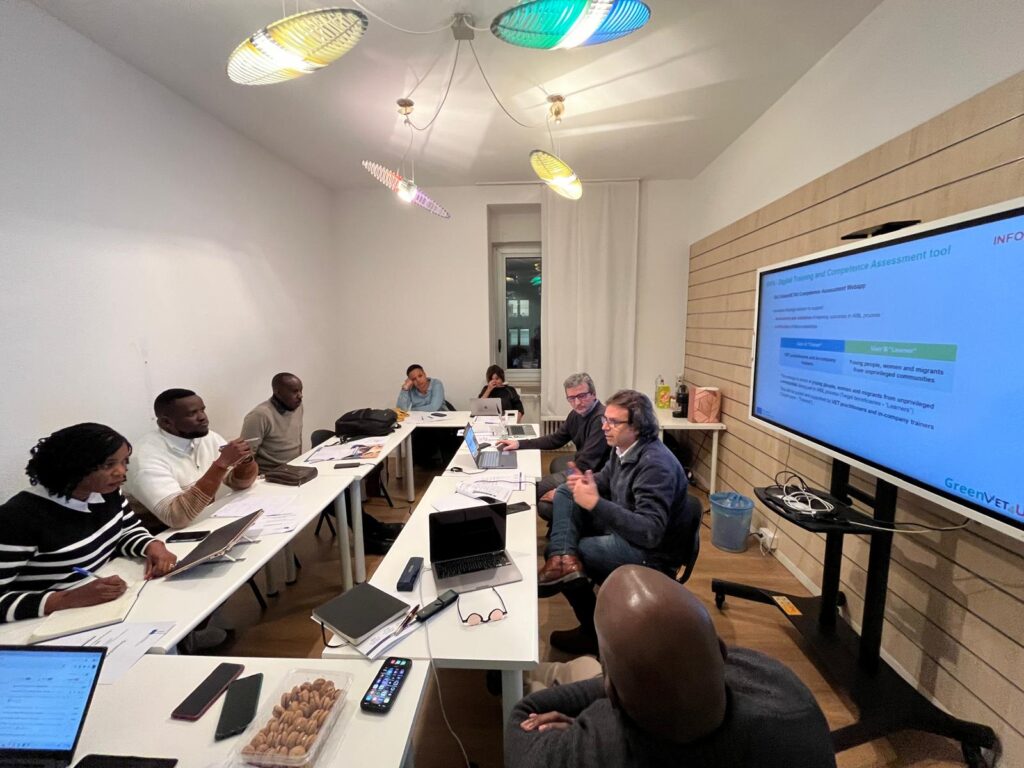
A few days ago, the GreenVET4U consortium held its 4th Transnational Partners Meeting (TPM4) in Milan, Italy, kindly hosted by project partner Centro Servizi Formazione (CSF). The three-day meeting brought together project partners to review progress, coordinate upcoming activities, and continue joint work on the development of innovative curricula and validation tools for skills for green jobs in Uganda. The meeting started with a study visit to CSF’s training centre in Vigevano, where partners had the opportunity to explore local training practices in a real vocational education and training (VET) environment. The visit encouraged exchange of experiences and reflections on how training provision can respond to labor market needs. During the following working sessions in Milan, partners focused on key project components, including the validation of the e-learning courses, the development and testing of digital tools for competence assessment, and the preparation of the piloting phase based on micro-credentials. TPM4 was an important milestone for aligning methodologies, strengthening cooperation among partners, and ensuring coherence across project outputs as GreenVET4U moves into its next implementation phase.
Uganda’s TVET reform opens new opportunities for green skills development

Uganda is undergoing a major transformation in its Technical and Vocational Education and Training (TVET) system; a change that aims to make vocational education more relevant, practical, and aligned with the country’s labour market needs. The recent establishment of the Uganda Vocational and Technical Assessment Board (UVTAB) and the ongoing TVET reforms mark a decisive step towards improving the quality and impact of vocational training across the country. These reforms seek to modernize the way training institutions prepare young people for employment, with a strong emphasis on competence-based education, industry collaboration, and skills that support sustainable development. As the world, and Uganda, moves toward greener economies, the demand for workers trained in environmental management, renewable energy, waste management, and sustainable tourism continues to rise. However, for these reforms to achieve their full potential, VET practitioners and in-company trainers play a crucial role. They are the link between policy and practice, between innovation and the classroom. That is why building their capacity to design and deliver modern, green-oriented curricula is essential. This is precisely where the GreenVET4U project contributes to Uganda’s evolving TVET landscape. Through collaboration between Ugandan and European partners, the project is developing an innovative capacity-building programme aimed at empowering VET educators to become true agents of change in their institutions and communities. In the coming months, GreenVET4U partners will be working on a set of e-learning courses that will soon be available on the project’s Online Platform. These courses will strengthen the skills of VET professionals in six key areas for the design and delivery of innovative curricula in skills for green jobs; from building business-education partnerships to integrating digital technologies and promoting inclusion and sustainability in training. As Uganda’s TVET sector embraces reform and innovation, GreenVET4U stands ready to support educators and trainers in taking the next step: equipping a new generation with the skills and mindset needed to thrive in the green economy.
New learning opportunities coming soon on the GreenVET4U e-Learning Platform

Across Uganda, many VET practitioners and in-company trainers face a common challenge: how to align training programmes with the fast-evolving demand for green and sustainable jobs. Limited access to digital tools, updated curricula, and opportunities for professional growth often make this task even harder. The GreenVET4U project is addressing this gap by equipping VET professionals with the skills, tools, and resources they need to deliver innovative training for the green economy. Over the next few months GreenVET4U partners will be working on the development of the set of e-learning courses that will soon be available on the e-Learning Platform: a digital space designed to support the continuous professional development of VET practitioners and in-company trainers in Uganda. These upcoming courses will help VET professionals strengthen their skills and capacity to design and deliver innovative curricula for Green Jobs, becoming true agents of change in their institutions and communities. Each course will address one of the six Building Blocks for the Design and Delivery of Innovative Curricula in Skills for Green Jobs, focusing on key areas that are essential for modern vocational education: Building partnerships between businesses and education for curriculum design and work-based learning. Identifying the skills needed for green jobs. Introducing green entrepreneurship into training programmes. Integrating digital technologies into the curriculum. Promoting inclusion, diversity, and civic participation in training delivery. Ensuring quality assurance and validation of competences through digital tools. Through the GreenVET4U e-Learning Platform, users will also access other valuable resources such as the Guide on Digital Competencies for Virtual Learning and the Lesson Plan, both aimed at helping trainers adapt their teaching to modern, digital environments. The e-learning courses, together with the upcoming GreenVET4U Competence Assessment Webapp, will provide trainers with practical tools to guide, assess, and validate learners’ skills for Green Jobs
From trainer to changemaker: Empowering Uganda’s VET professionals for a greener future

Behind every green job, there’s someone who taught the skills to do it. And in Uganda, that person is often a vocational trainer working with limited resources, little support, and a huge responsibility: preparing the next generation for a fast-changing, sustainability-driven economy. In Uganda’s journey toward inclusive green growth, one figure stands out as a key agent of change: the VET professional. While most development programmes focus on learners, infrastructure, or equipment, GreenVET4U flips the perspective—investing instead in the people who train others. This is more than a technical approach. The project recognises that trainers are not just educators; they are multipliers of innovation, role models in their communities, and drivers of systemic change within vocational institutions. That’s why GreenVET4U focuses on building the capacity of VET providers and in-company trainers to design, deliver, and test green skills curricula that are both relevant and resilient. Trainers will gain the tools to lead Uganda’s green transition from within; especially in two sectors where this change is most urgent: eco-tourism and waste management. But it’s not just about curriculum. It’s about mindset. The project promotes a shift in how vocational education is perceived and practiced. It encourages critical thinking, green entrepreneurship, digital competence, and civic engagement—turning traditional trainers into forward-thinking facilitators of sustainable development.
Virtual Innovation Lab: a new collaborative space for co-creating green VET solutions

The GreenVET4U project introduces the Virtual Innovation Lab (VIL) — a dynamic, collaborative space designed to connect VET providers and practitioners from Uganda and EU countries. This virtual lab fosters creativity, dialogue, and joint project development, all in support of one shared goal: driving innovation in vocational education for green jobs. Whether through brainstorming ideas, sharing resources, or outlining projects together, members of the Community of Practice (CoP) and their invitees are now working side by side — asynchronously and in real time — to co-create new VET project ideas tailored to real challenges across Africa and Europe. Inside the Virtual Innovation Lab, participants can: Share reflections on common VET challenges in Uganda and Europe Brainstorm and track solutions to skills mismatches and green transition needs Co-develop project ideas Access and work with the GreenVET4U Competence Matrix on Design and Delivery of Innovative Curricula in Skills for Green Jobs Contribute to a growing resource wiki with funding opportunities and good practices Collaborate through meeting notes, calendars, and a dedicated discussion board If you’re a new member of the Community of Practice (CoP) or have been invited to join the Virtual Innovation Lab, start by visiting the Welcome section. There you can add your profile and explore the calendar of upcoming meetings. Once inside, you’ll be able to connect with peers and make full use of all collaborative tools the Lab has to offer. You can access the Virtual Innovation Lab from the “Project Results” section of the GreenVET4U website.
New competence matrix for designing green VET curricula now available
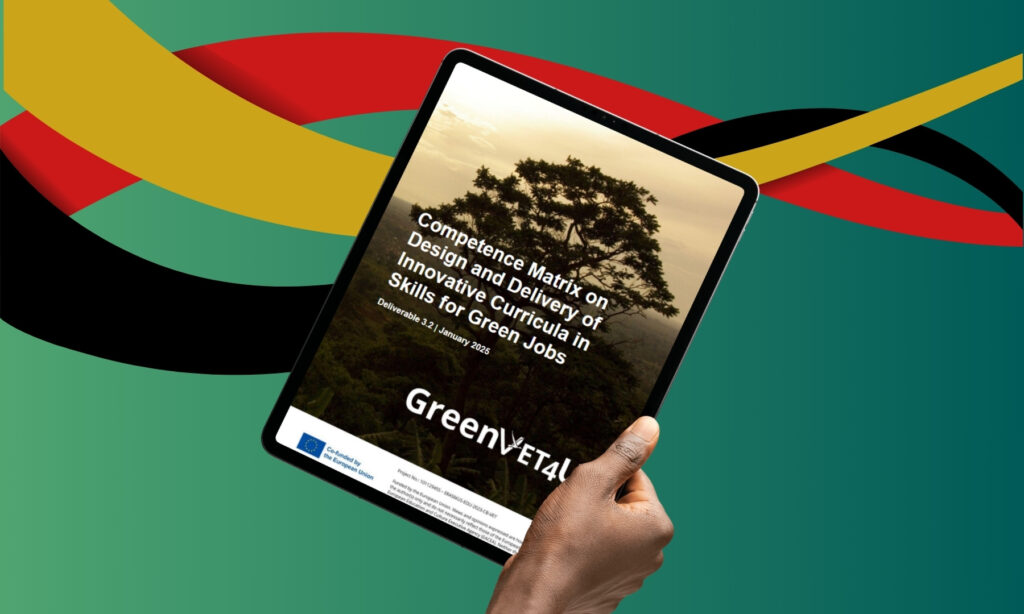
The GreenVET4U project has just published one of its most essential tools to date: the Competence matrix on design and delivery of innovative curricula in skills for green jobs. This comprehensive reference document lays out, for the first time, the set of competences that VET practitioners and in-company trainers in Uganda need to design and deliver training programmes truly aligned with the green jobs of tomorrow. It’s not just a technical framework—it’s a response to real needs, shaped by Uganda’s local context and grounded in both national priorities and international best practices. The matrix is built around six strategic areas of competence, each one broken down into focused Units of Learning Outcomes. These units define, in concrete terms, what trainers need to know, do, and manage when developing effective green curricula—covering everything from business–education partnerships and labour market analysis, to digital learning, inclusion, and quality assurance. What makes this matrix especially valuable is its structure: it doesn’t offer vague recommendations, but instead provides clear, assessable learning outcomes along with performance criteria and descriptors for knowledge, skills, responsibility, and autonomy. This means it’s not only informative—it’s usable. Behind its development is a thoughtful, collaborative process. The project team analysed leading European frameworks (like GreenComp, EntreComp, DigiComp, and EQAVET), filtered them through Uganda’s specific challenges and potential, and translated them into something that speaks to the day-to-day realities of Ugandan VET professionals. Whether you’re a curriculum designer, a trainer, or someone shaping policy, this matrix is designed to support real change in how green skills are taught and learned. And it’s flexible. The matrix aligns with levels 5 and 6 of the European Qualifications Framework, meaning it can support both technical profiles and more strategic, leadership roles in training institutions. By using this tool, VET professionals in Uganda will be better equipped to develop training that promotes sustainability, entrepreneurship, and inclusion—while helping young people access meaningful employment in a growing green economy. You can download the Competence Matrix at this link or find it in the Project Results section of our website.
GreenVET4U Newsletter | April 2025

Our newest edition is now available, featuring project highlights, recent activities, and key reflections on green skills and vocational training in Uganda. Don’t miss out on updates, partner news, and what’s coming next in GreenVET4U. Click below to read it! Download the Newsletter
A strategy to connect skills, jobs, and sustainability in Uganda

GreenVET4U has released a foundational document to guide the transformation of vocational education and training in Uganda: the Strategy for VET curricula development and Work-Based Learning (WBL) skill provision for green jobs in Uganda. This strategy responds to a pressing reality: Uganda’s VET system must evolve to meet the challenges—and possibilities—of a green economy. With a growing youth population and high unemployment, especially among the most vulnerable, the need to rethink how skills are delivered is more urgent than ever. And this document is a key step in that direction. Firmly grounded in Uganda’s own development roadmap—like the TVET Policy (2020), the National Development Plan III, and the Uganda Green Growth Development Strategy (UGGDS)—it also reflects shared priorities with the European Union, including green growth, education reform, and empowering young people. This isn’t just a policy paper—it’s a practical, forward-looking guide. It identifies six strategic competence areas that should steer future curriculum development and training efforts across the VET sector: Strengthening collaboration between education providers and businesses, to co-create training and ensure quality work-based learning Translating labour market needs into real occupational profiles and relevant training Encouraging green entrepreneurship and innovative mindsets in the classroom Embedding digital skills and tools into both curriculum design and assessment Promoting inclusion, civic responsibility, and shared values in learning spaces Building stronger quality assurance systems and improving how learning is validated Each of these areas will inform the development of flexible, outcome-based learning units tailored to Uganda’s green sectors. The strategy also outlines how Work-Based Learning can become a central pillar of green skills development. It recommends adaptable learning formats—from apprenticeships to community-based projects—and provides guidance on how to involve employers meaningfully, support learners, and ensure placements lead to real learning. This document sets the tone for what comes next in GreenVET4U. It offers a clear vision and a set of actionable principles to help vocational training in Uganda grow into something more inclusive, more relevant, and much more future-facing. You can access the full strategy at this link or directly from the Project Results section of our website.